Four insights from reading The Four Agreements
{from February 2nd 2024}
Recently, I read “The Four Agreements” by Don Miguel Ruiz, an interesting book I would recommend to anyone interested in personal freedom, personal growth, and exploring the way our minds work. It’s quite short but I made a point of taking my time with it because it is full of wisdom and insights and you know how I love to give ideas time.

I am not going to go through the entire book - if you are curious, I suggest you read it for yourself. But I do want to share a few of my favourite quotes from it. The ones that I found to be very important, impactful or even some that I believe deserve to be further explored.
Domestication of humans
My favourite part of the book was the description of the process humans go through as we learn about the world and its (perceived) rules. Through this process, we are taught about what is important and what isn’t, and we learn about our place in the world.
I call this process the domestication of humans. And through this domestication we learn how to live and how to dream. (Ruiz, 6)
It is the formation of our self-concept and belief system. Ruiz calls this our “Book of Law”. The Book of Law is the collection of all our beliefs about ourselves, other people, and how the world works.
The interesting part is that when we are young, we are trained to learn what is “good” and what is “bad” through a system of rewards and punishments. Some of these, we still remember today, but most of them, we are not even aware of.
Once we begin to agree with what is being taught to us, we internalise that belief - and that is how we become our own domesticators later in life. We feel good after doing something we believe was “good” and we punish ourselves for things we believe are “bad”.
The domestication is so strong that at a certain point in our lives we no longer need anyone to domesticate us. We are so well trained that we are our own domesticator. (Ruiz, 8)
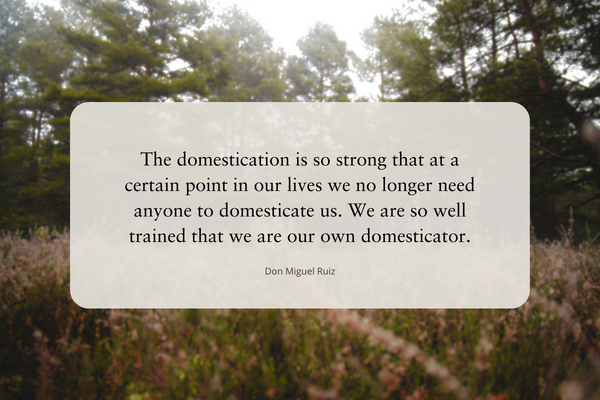
This is the first point I wanted to highlight - the invitation to become aware of our internal Book of Law and to notice all the ways in which we domesticate ourselves to make sure we do not go against it.
The thing is that this internal Book of Law has nothing to do with what is true and what isn’t. Its main purpose is to make us feel safe. That is why we tend to discard any information that may indicate that some ideas, beliefs, or rules in the Book are false.
However, following this Book of Law often keeps us in cycles of unnecessary pain and suffering - through our punishments or the pain of the discrepancy between our ideas and reality.
Which is why it can be helpful to observe what our internal Book of Law is made of and recognise which beliefs (or agreements) from it are not serving us anymore.
Agreements
Another idea I would like to take from the book is that this Book of Law - your self-concept, your belief system, however you call it - is comprised of countless agreements that you have made.
There are thousands of agreements you have made with yourself, with other people, with your dream of life, with God, with society, with your parents, with your spouse, with your children. But the most important agreements are the ones you made with yourself. In these agreements, you tell yourself who you are, what you feel, what you believe, and how to behave. (Ruiz, 21)

The thing I like about the word “agreement” in this context is that, firstly, it is accurate, and secondly, it brings attention to your own role in everything you believe, think, do, and so on. It brings attention to your personal responsibility.
Whenever we hear an opinion and believe it, we make an agreement, and it becomes part of our belief system. (Ruiz, 35)
On that note, when talking about being impeccable with your word, Ruiz also points out an important distinction:
When you are impeccable, you take responsibility for your actions, but you do not judge or blame yourself. (Ruiz, 31)
People tend to conflate blame and responsibility all too often. This is actually a subject that is very dear to me, and you can probably expect a full article on this topic sometime in the future 😉
Being honest with yourself
The next quote I want to put in the spotlight actually doesn’t play a big role in the book but I find it to be one of the crucial keys to personal growth and happiness:
Or maybe you need to stop lying to yourself about what you truly want. (Ruiz, 69)
The invitation to stop lying to yourself is the first element of this quote I find transformative.
Being completely, radically, brutally, wholeheartedly honest with yourself is by far the best thing you can do for yourself, for your life, and for the people around you.
That’s the start of true transformation and growth.
The next element is to be honest with yourself about what you truly want. To some people, this may seem pretty obvious - lucky you! To many of us, however, recognising what we actually want can be a long process, full of unlearning and facing your shadows.
Because you always want something. And if you are not honest with yourself about it, you will subconsciously work on achieving it - which may work out well or it may involve some manipulation, lying, avoidance, unwanted behaviour, and a lot of other unpleasantness. All too often people who guilt-trip and manipulate others don’t really do it consciously. But they do it because they do not allow themselves to admit to themselves what they truly want.
So even though this is not one of the main themes of the book, the quote above really stood out to me and I wanted to share why I found it so vital.
Be human
The last message I wanted to share from the book is another big and important one. It is about believing that it absolutely is possible for each of us (yes, including you!) to grow awareness and relax into our true nature.
Our normal human tendency is to enjoy life, to play, to explore, to be happy, and to love. (Ruiz, 95)
Ruiz tells a story about a man who went to a Buddhist temple and asked a Master there, “Master, if I meditate four hours a day, how long will it take me to transcend?” And the master replied it would take him ten years. Then the man asked, “What if I meditated eight hours a day, how long will it take me to transcend?” And the master replied it would maybe take twenty years.
The man was surprised and wanted to know why it would take him longer if he meditated more. To which the Master replied:
“You are not here to sacrifice your joy or your life. You are here to live, to be happy, and to love.” (Ruiz, 78)
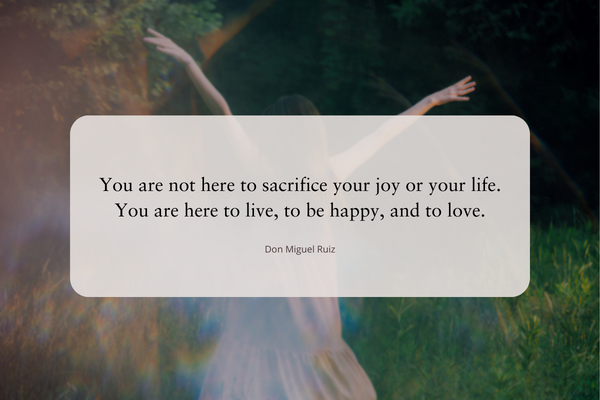
Let this be the thought you carry from today’s post into your everyday life ✨
I hope you have a wonderful rest of the month!
See you soon,
Katja
Source
Ruiz, Miguel. (1952). The four agreements: a practical guide to personal freedom. San Rafael, California: Amber-Allen Publishing Inc.